
Everyone’s using AI.
Almost no one has been changed by it.
The training programme that changes how your organisation works. AI produces the work; your people direct it.
Per person, once. Pay by card and you’re in within the hour, or take an invoice.
A short form and a reply from the founder. Most people book straight into his calendar.
31 organisations so far. The results you’ll see are measured from each person’s real work.
How a listed company changed the way it works
accesso plc · AIM-listed · five leaders, on camera
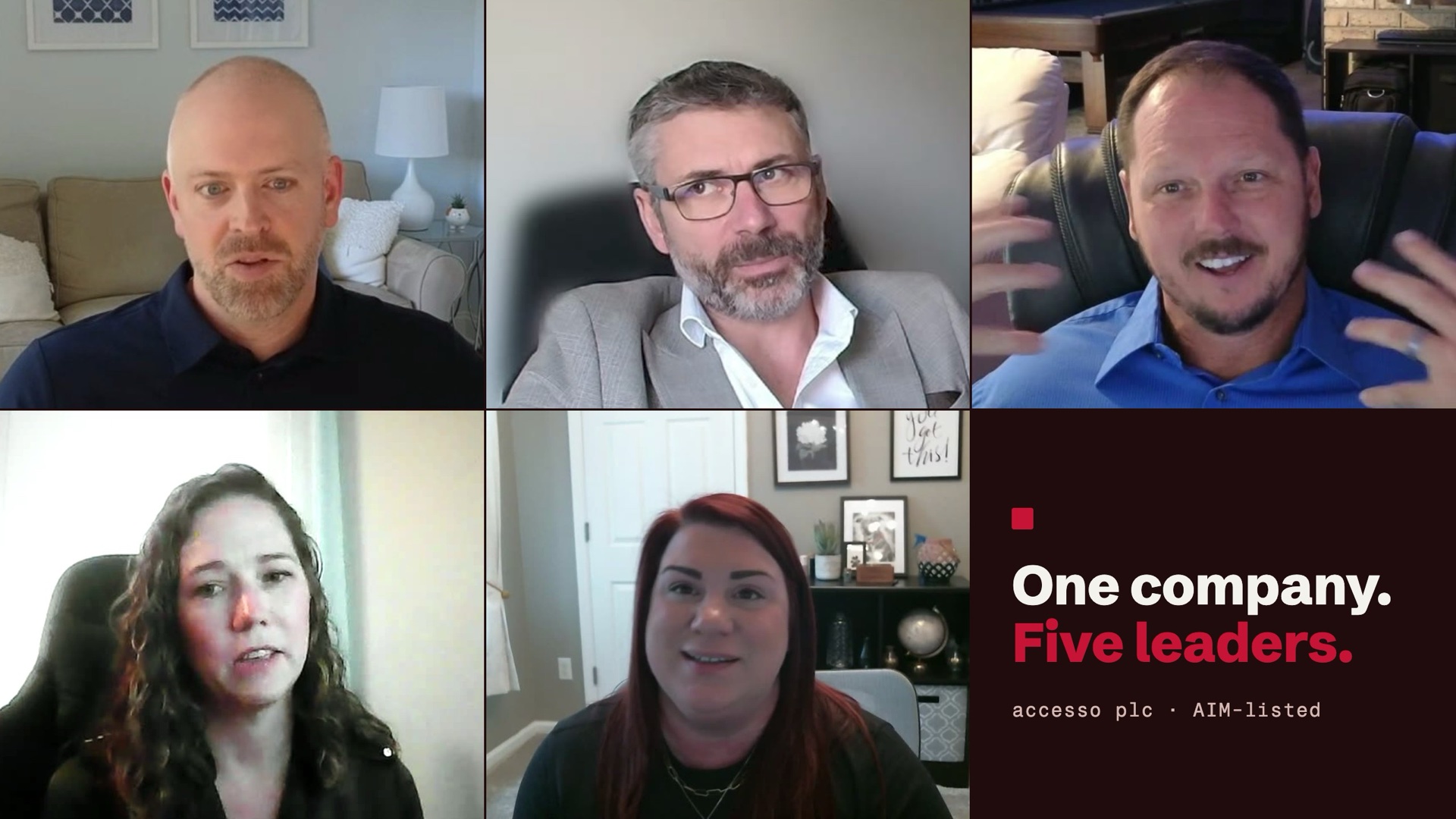
Brian Bottini · Chief Product Officer
Lee Cowie · CEO
Mike Hulsman · SVP Operations
Alyssa Potts · Director, Client Success
Alyssa Deveroux · Director, Client Solutions
31 organisations so far. The results you’ll see are measured from each person’s real work.
The people who work this way now, on camera. Click any face for their verdict.
The gap
You have the licences. Some people paste things into a chatbot; some run agents that genuinely produce. Either way, two things hold. AI makes a fraction of the work; the rest is still made the way it was three years ago, by hand, by your busiest people. And every piece starts cold. The AI knows only what somebody hands it that day, so nothing compounds.
Ask your team, and yourself. What did you use AI for in the last twenty-four hours? Five per cent of your work, or all of it?
For most people the honest answer is a sliver. The words leaders use with us: “honestly, a glorified Google.” For the furthest along it’s more, and still nowhere near all of it.
The gap is invisible from the inside, because the tools feel useful. And it compounds quietly. Every month the distance widens between how your organisation works and how it could, while everyone feels like they’re keeping up.
We’re not describing this from a conference stage. We live it. Every document, plan and email this company produces is AI-produced under human direction, and has been since day one.
The cause
The gap has one cause, and it isn’t the tools.
For the first time, intelligence exists outside a human head. Until now, all the thinking your organisation could deploy lived inside people. Now intelligence is on tap, and almost no one can wield it.
Here’s why. A frontier model has been trained on close to everything, yet the one thing it has never seen is what would make the work yours: your clients, your projects, your standards. So, left to itself, it gives everyone the same thing. Competent, generic output. The average of everything. It’s a painter with every colour on the palette, mixed into one muddy brown. Hand the same painter a clean palette, just the colours this picture needs, and you get the picture you asked for.
The missing ingredient is context. With the right context, AI can do almost anything to a professional standard. Choosing and managing it is a real skill, and almost nobody teaches it.
The real shift isn’t “use the tools better”. It’s an inversion:
Stop working with AI’s help.
Have AI produce the work — all of it — while you direct, supervise and approve.
Most people use AI as a guide. The shift is AI as the engine. A guide hands you 10%-shaped gains; the engine’s gains are 10×-shaped. A different kind of change, not a promised figure. The constraint it removes is the person, typing every output into existence.
One test tells you which side you’re on: is AI producing all of your output? If not, the shift hasn’t happened yet, however many tools you use.
Watch it happen
This is where words stop being the right medium, because the inversion sounds like hype until you watch it.
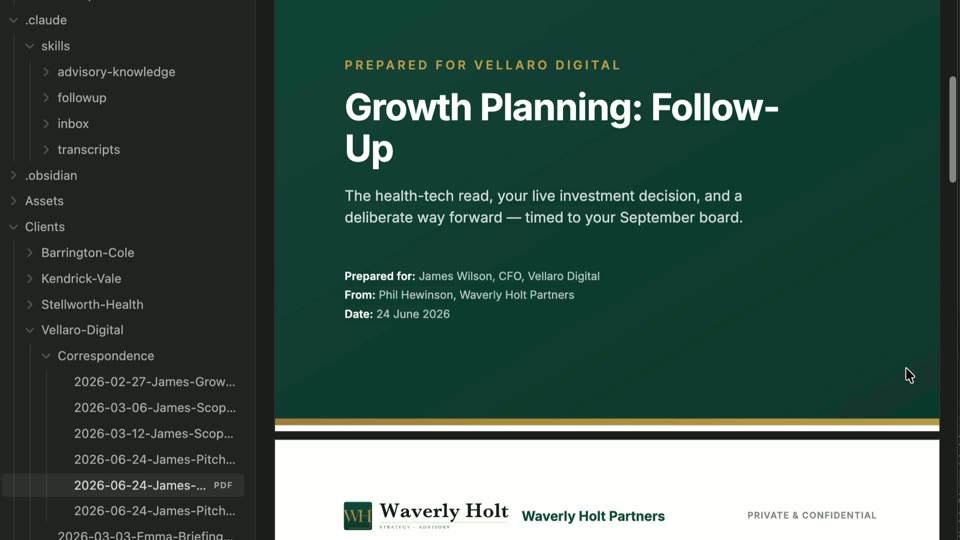
A professional speaks a single word and gets back a finished piece of their actual work. On their letterhead, in their voice, right on the details, because the AI read their context first. No prompt engineering. No editing marathon afterwards. Direction in; finished work out.
Why it works
Four ideas carry the whole method. Each is simple to say and a discipline to live. That is why this is training, not a tip-sheet.
A structured, growing record of your working world. Your clients and stakeholders, your projects and their history, your standards, your decisions and the reasons behind them. All of it captured as plain files that AI reads before every piece of work. Nothing gets re-explained. It builds task by task as you work. There’s no heroic set-up week. And you don’t invent the structure. The training hands you patterns proven in daily use. We call it your shared brain. Shared between you and your AI, and genuinely yours. Plain files on your machine, readable by you, portable to any AI model, yours for good.
Context discipline. The shared brain is the library. The skill is knowing what to pull off the shelves for each task. This is the core craft of working well with AI. The difference between muddy brown and the picture you asked for. No tool course reaches it.
Human supervision. You read, direct and approve everything that matters. Nothing ships without your judgement. That’s a deliberate design choice, the opposite of the autonomous-agents direction. Governance is built into how the work is produced, not policed afterwards.
The Multiply Method. Knowing all this changes nothing. The hard problem is behaviour change, because what’s being rewired is how you’ve worked your whole life. So the programme is engineered on peer-reviewed learning science. How content is structured, how it sticks, and how it turns into habit. And it personalises like nothing else you’ll evaluate. Your first task uses the client and project you typed into onboarding minutes earlier. Every end-of-module reflection rebuilds your next module around where you actually are. The exercises are not homework beside the day job. They are the day job. The science, in full: The Multiply Method (PDF).

Built by Phil Hewinson: twelve years at Monzo, Meta, Google and Microsoft; two companies founded, one sold; most recently Chief Product Officer at Alpha School, delivering AI-powered learning at scale. Cambridge computer scientist.
Monzo · Meta · Google · Microsoft · Alpha School · Cambridge
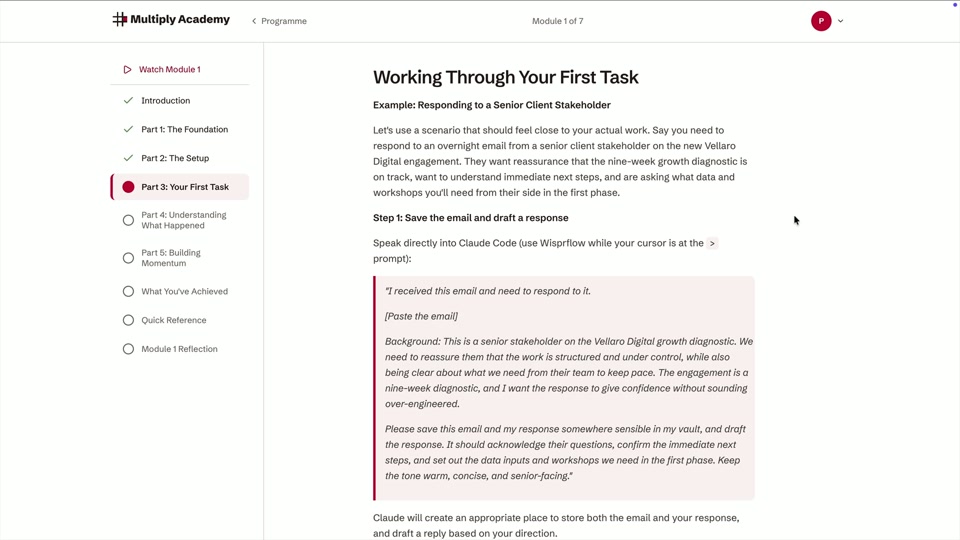
Twenty seconds inside the platform: the real product, not a mock-up.

The results
You shouldn’t believe any of this on our say-so. Here is how belief arrives.
First, people like you. Senior, named, on camera, including the ones who arrived sceptical.
(Watched the film at the top? These are the individual stories.)
Then the number, measured from real work.
Trainees work through their real tasks. So each person’s own AI audits the work in their files. It computes what it would have cost by hand. The result is an output multiple. What a person now produces, divided by what the same hours could have produced manually. The denominator is their available focus time, meetings excluded.
No rival discloses a measurement method at all. Ours: the audit runs on the person’s own machine, by their own AI, over their real work. It is anonymised before anything leaves. And the limit of the claim: the multiple is demonstrated capability, not a guaranteed weekly average. We publish medians so the claim under-promises.
Then money. Take a professional costing $75,000 a year all-in. At the 2.2× median, the programme recovers its price in about three weeks. Then run it with your own numbers: arithmetic, not optimism.
The full dataset, with the method, is yours to take away: the Impact Report (PDF)No email required.
Your organisation
You can’t lead a change you haven’t felt. Organisations don’t reinvent around AI until their leaders have personally felt what AI-produced work is like. You’re one person in two roles. The professional, whose own output multiplies. And the leader who then knows, not believes, what it means at scale.
Where it compounds. Each person builds a shared brain. Team by team, those brains can connect at the layers each person chooses to share: standards, project context, institutional memory. The personal stays private. Connect enough of them and you’re looking at a company brain. Your organisation’s accumulated context, owned by you, read by AI in everything anyone produces. There’s a name for that: intelligence sovereignty. Plain files on your machines, portable to whichever AI model wins, never a vendor’s platform. For a growing organisation this is the grow-without-hiring route. Output scales with capability, not headcount. Leaders usually start designing it in the room: which layers are corporate, which departmental, which personal. The instinct is right. Skills first, architecture after.
What it does for your people. The prevailing pattern centralises. A central AI team builds agents, two layers away from the actual work. One question cuts through it. Who has more context for a role: the central team building an agent for it, or the person who’s done the job for twenty years? We train the people who already hold the context. The capability stays in them. Empowerment compounds; automation hollows.
Different in every function, so we show it:
And when a team does this together, you can see it. The dashboard: adoption, progress and measured impact on one screen. Who needs attention, one-click check-ins, peer inspiration that spreads what works. Nurture, not spying: only each person’s anonymised summary ever leaves their machine. When the board asks what you got back, the answer is one click.
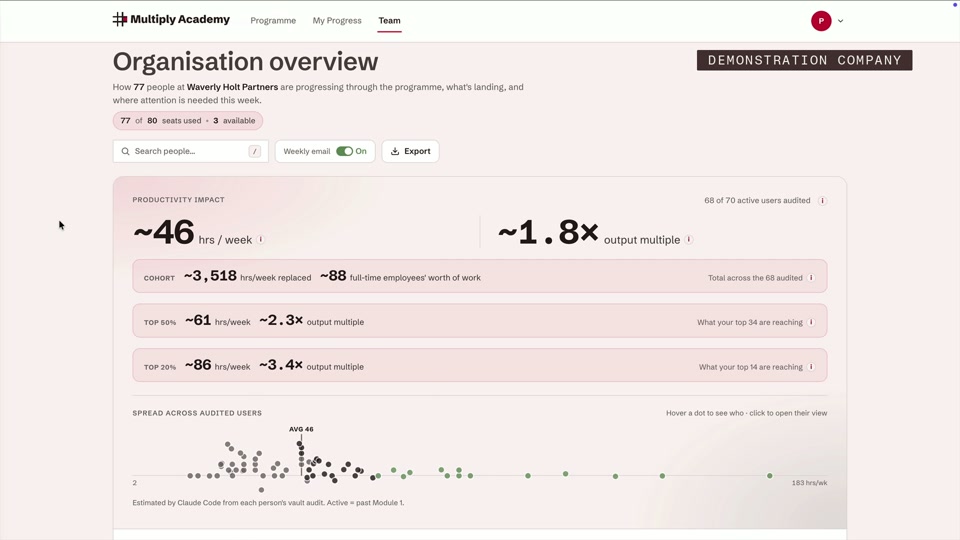
(Filmed on our demonstration company: fictional org, real product.)
The honest map
You’re going to compare options. Here is the map we’d want if we were you.
Tool courses.
The crowded shelf: vendor tutorials, video libraries, monthly memberships. Plenty are cheap; some are free, and for familiarity, the free ones are decent. The problem is the ceiling, not the price. They teach the tool, and the best teach it well. But a way of working isn’t a feature a tutorial can show you. No measured outcome exists anywhere on that shelf.
Licences alone.
“Buy everyone the AI and let them at it.” A licence distributes potential, not practice: every organisation now owns more AI capability than it uses, and without the skill, usage plateaus within weeks.
Consultants and central builds.
Genuinely capable, while they’re there. The problem is where the capability accumulates: in their people, their plumbing, their retainer. When they leave, it leaves.
Us.
We install the capability in your people, once. It compounds with use, transfers to whichever AI models win, and can’t be taken away by any vendor, including us.
The question to anchor any comparison on: after each option, who is permanently more capable?
And price it against the class of spend it actually belongs to: executive education, professional certification. One-time, career-long, routinely $2,500–$12,000 per person. The band is familiar; what sits inside it isn’t. That money usually buys a few weeks of lessons about a subject. This installs a way of working, on each person’s real work, and measures the result. One more difference, and it’s the point: that shelf is bought for a few seats at the top. This is built for the people who do the work. They hold the context, and the return is measured per person. The fiftieth person carries the same case as the first. The full price is one scroll below.
The programme and the price
Seven modules. Not lessons about AI: your actual work, moved across, module by module. Personalised from the first task. Your first result lands inside a focused 3–5 hour block.
Getting Started.
Your first real piece of work from AI that knows your world, in one sitting.
Context Management.
AI stops being hit-and-miss: reliable quality, even on big documents.
Vault Architecture.
Your shared brain built out; every task starts from rich context, never a blank page.
Core Workflows.
Meetings end with notes, actions and follow-ups drafted; one spoken word runs your daily routine.
Working Smarter.
Several pieces of work running in parallel; your specialist knowledge written down once, raising everything after.
Working at Scale.
A twenty-company analysis in a day; review across hundreds of documents; multi-week projects with nothing re-explained.
Full Mastery.
An expertise engine built from the best sources in your field; AI working in your browser; every output AI-produced, under your supervision. (All of it.)
per person, one-time
No UK VAT applies
About ten weeks, done through your day job
Self-paced, no cohorts or start dates: you begin when you buy
Pay once. The capability is permanent.
Per person, once. Pay by card and you’re in within the hour, or take an invoice.
A short form and a reply from Phil. Most people book straight into his calendar.
Put one focused 3–5 hour block in your own calendar this week. Your first finished piece of work lands inside it.
You won’t be doing it alone. Everyone gets us on email (that’s Phil, not a helpdesk), and teams get a kickoff and check-ins.
Five people or more? Talking to us first is just as good a route. You get rollout design, the dashboard configured to your reporting lines, and a security review with your IT. The checkout stays open either way.
Not the budget-holder? The expense pack writes the approval email for you.
Registered charity? Your rate is $2,000 · get your charity rate
Who this isn’t for.
One exclusion, and it’s the one that matters. If you want AI to be someone else’s job (a central team doing it for your people), it won’t stick. We’d rather say so than take your money.
Built for the rest.
Almost all knowledge work: days made of documents, email, analysis, decisions and plans.
Your questions
The questions serious buyers ask late, when it matters. Ask us all of them.
“Where does our data go?”
Nowhere without your say-so; that is the design. Your shared brain is plain files on your own machines. Nothing in it is sent to, or seen by, anyone unless the person working chooses to send it. Task by task, they direct what context the AI reads and supervise everything that comes back. That discipline isn’t an add-on: managing what’s loaded is the skill we train. The same practice that makes your people effective is what keeps your data governed. Your organisation holds its own layer on top. Policies for what may be shared, which tools are approved, and the enterprise agreements governing the AI itself. On commercial plans the model provider is contractually prohibited from training on your data. That’s the default, not an opt-out. Where you have a hard constraint, we scope honestly around it rather than talk past it. Everything your security team needs is on one page, paper included. Many organisations name data control as their biggest AI barrier. They tend to find this is the version of AI they can actually approve. The listed company at the top of this page did.
“Where do the hours come from?”
This is the real objection under most others, so here is its honest shape. The programme is done through the day job. Modules typically take three to five focused hours each (the final one more). The exercises are each person’s actual work, produced to standard. The hours make real output while the skill installs. Everything not yet moved across simply continues the old way. The new way typically takes over most of a person’s work after Module 4. And whatever moves across multiplies. What genuinely dips mid-programme is confidence, not output. That is the implementation dip that shows up in any real behaviour change. The Method builds support at the exact week it bites. So the answer to “we’re too busy”: this is not another thing on the pile. It’s the way over the pile. What it frees is precisely the capacity you’re short of.
“What happens to our people?”
Elevation, in two steps. First AI amplifies what a person is already good at. A senior professional directing AI outperforms a junior directing AI. Expertise is the multiplier, not the casualty. Then it raises their ceiling: more scope, more judgement, work they couldn’t previously take on. The way a senior manager grows when the team does. The threat worth taking seriously is different. Not AI replacing professionals, but AI-equipped professionals replacing those who never adapt. Training your people puts your organisation on the right side of that line.
“Won’t better models make this obsolete?”
The models are the intelligence, and intelligence only works with context. A model company doesn’t have the context to know what context to store about your world. Only your people do; that is the skill. Your shared brain is plain, portable text. Point today’s best model at it, or tomorrow’s. Your accumulated context comes with you, whoever wins. Better models raise the ceiling on what well-directed context can do. So the skill gets more valuable, not less. No lock-in is a feature.
“Do people actually finish, and does it stick?”
People pause; life gets busy. Genuine disengagement is rare: 91% of reflections along the way are positive. The completion record is in the Impact Report. The first “this changes things” moment lands inside Module 1, on your own work. From there, momentum is a structure problem. That is why the structure exists. And months in, the verdict of the people who finished isn’t “we still use it”. It’s that this is how they work now.
“What makes this different from other AI training?”
Most of the shelf teaches the tool, or at best how to think about it. Useful for familiarity, and capped, because the tool was never the shift. We change the working relationship itself: AI produces the work; your people direct it. On their own real work, from the first task. And we publish what nobody else will. Results measured from real output, method disclosed, medians rather than cherry-picks. Comparing providers? Ask each one what outcome they measure, and how they measure it.
Registered charities and non-profits
The charity rate is $2,000 per person: published, not negotiated. You give your charity’s registration number at purchase (any national register: UK charity number, US EIN for a 501(c)(3), OSCR, CCNI, or your country’s equivalent). The rate applies straight away, and the receipt names your charity. Get your charity rate.
“I’m buying this for myself”
The published price is for organisations buying for their people. If you’re paying personally, check whether your employer will before you do: the expense pack gives you the email to send, a proforma invoice, and a receipt in the company’s name. If you’re a founder buying for a business you own, get in touch.
What happens after twelve months?
Access to the platform runs twelve months from each person’s registration: breathing room, and nobody needs that long. What you keep is permanent: the skill, the way of working and your shared brain are yours for good, on your machines. We expect to offer a lower-priced renewal for ongoing platform updates; it doesn’t exist yet, and nothing about the programme depends on it.
How long does it really take?
About ten weeks at a typical pace, and it’s self-paced: no cohorts, no start dates, you begin when you buy. Modules run from two to five focused hours each (most are three to five, and the final one is longer), roughly 25–35 hours in total. Most people are operational after Module 1.
What tools do I need, and what do they cost?
Three, and this is the whole list. Claude Code, Anthropic’s agentic tool, the one that does the work. It needs a paid Claude plan: about $20 a month to start; heavy daily users typically move to about $100, and organisations provision them centrally. Obsidian is free. Wispr Flow for voice is about $12 a month. No technical background needed: Module 1 walks you from install to your first finished piece of work. Expect your AI usage to rise as your output does. That’s the right way round: it’s a productivity cost, not a tool cost, and managing context well (the skill we teach) is what keeps it efficient.
Why Claude Code?
The programme is taught on Claude Code, and you’ll need it throughout. The reason is who controls the context: it works across your whole shared brain (plain files you own) rather than the slice a product shows you. Your saved ways of working stay directly in your hands. We evaluated the alternatives hands-on and re-test as they evolve. The boundary that matters: the tool is required; your context is not locked to it. The shared brain is plain text, and it moves with you to any model. Full argument: Why Claude Code.
What support do we get?
As much as you want. Every learner gets the personalised platform and us on email (that’s Phil, not a helpdesk). Teams get a kickoff, goal-setting, check-ins that taper as your team finds its feet, and the dashboard, so you see progress without chasing it and we catch anyone struggling early.
How does buying actually work?
Pay by card and you’re in within the hour, or take an invoice if that suits your finance team better. You’ll get a receipt straight away, and an invoice in your company’s name if you need one. Buying for others? Pay now and add names after: a place isn’t tied to an email address. Nothing breaks if a colleague signs in with a different account, and nothing is locked until each person starts.
The other side
Here is where this goes, in the words of the people already there: AI stops being a tool they reach for and becomes the way they work, on everything. They speak their intent and review finished work. Their weeks hold more thinking and less typing.
The gap between the organisations working this way and the ones still thinking about it is widening either way. The only question is which side yours works on.
Per person, once. Pay by card and be inside Module 1 within the hour, or take an invoice.
A short form and a reply from Phil; most people book straight into his calendar. If we’re not the right fit, we’ll say so before you spend anything.
Need approval first? The expense pack writes the email for you.